Learn › Teaching › Student Evaluation, Assessment and Testing
Student Evaluation, Assessment and Testing
A mistake you did not name is a mistake being practiced. Assessment is how you find out what your learner actually knows — and the law of primacy is why finding out early matters.
Fundamentals of Instructing — FI.I.D
Why assessment exists
Every hour you fly with a learner produces information about what they can do without you, and none of that information does any work until it is said out loud and written down. That is the whole job: measure the performance against the standard, tell the learner where it landed, record it. The law of primacy is why the timing matters — what is learned first is learned best, and it is the hardest thing to unlearn. An error left uncorrected on lesson three is still there on the checkride, and still there the first time your former student flies with their family aboard.
Assessment also has a paperwork job. It is how you measure and document whether a lesson is complete, and what a stage check or practical test is built on.
What makes an assessment effective
An effective assessment is objective — measured against the standard, not against how much you like the learner or how tired you both are. It is flexible in tone, technique and content, because the same information lands differently on a confident learner than on a nervous one. It is acceptable, which is not about being gentle: an assessment is accepted because it comes from an instructor the learner trusts, and you earn that long before the debrief starts. It is thoughtful, meaning it respects the learner's self-esteem while it tells the truth. Honesty and bluntness are not the same tool, and only one of them is on the list.
It should also be comprehensive, constructive so there is something to build on, organized into a sequence the learner can hold onto, and specific. "Your landings need work" is not an assessment. "You are flaring high because you are looking at the numbers instead of the far end" is.
Traditional assessment
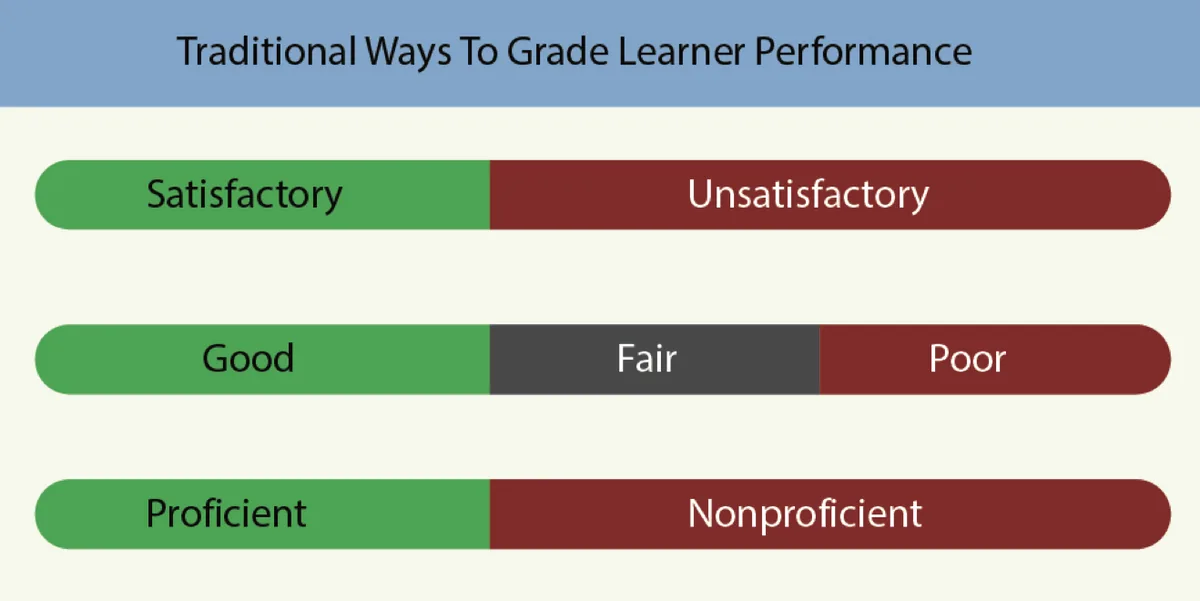
Traditional assessment is written testing — multiple choice, matching, true or false, fill in the blank. The Aviation Instructor's Handbook names a set of characteristics a good written test has, and it is longer than most candidates remember. Reliability is consistency, so the same test twice produces roughly the same result. Validity is content, so it measures what it claims to and not reading speed or trick wording. Usability is function — clear, deliverable in the time available, readable without interpretation. Objectivity is scoring that does not depend on who does the grading. Comprehensiveness is sampling the objectives broadly enough that the score means something. Discrimination is the test's ability to separate levels of achievement — a test everyone passes and a test everyone fails tell you the same amount, which is nothing.
Authentic assessment and the collaborative critique
Flying is not a written test, and a learner who can pass one may still be unable to make a decision in the airplane. Authentic assessment is learner-centered: a collaborative critique of a real performance, driven by open-ended questions rather than by you narrating what you saw. Four moves carry it, and the order is part of the answer.
- Replay — the learner talks you through the flight. You listen for where the replay does not match what happened, because those gaps are the lesson, and you discuss the discrepancies rather than correcting them flat.
- Reconstruct — what could have, should have or would have been done differently. The learner names it, not you.
- Reflect — what mattered most about that flight. This is the question that turns an event into a lesson.
- Redirect — connect the experience to similar ones, so it becomes a transferable rule instead of a story about one afternoon.
The reason to work this way is that the learner who says it owns it. The critique you deliver is information; the one the learner arrives at is a change in behavior.
Grading a maneuver
Maneuver and procedure grades run as a ladder, each rung naming how much help the learner still needs.
- Describe — can describe the physical and mental elements of the activity, but needs assistance to execute it.
- Explain — can also explain the underlying concepts, principles and procedures, but still needs assistance to execute it.
- Practice — can plan and execute it, with coaching, instruction or assistance to correct the deviations.
- Perform — executes it without instructor assistance, and identifies and corrects their own errors and deviations along the way. That self-correction is the entire difference between this rung and the one below it.
Not observed sits outside that ladder rather than above it. It records an item that was not accomplished or not required on that flight, and it says nothing at all about proficiency — do not let it read as a grade earned.
Landings are the clearest example. A learner can explain the flare beautifully on the ground and still need your hands nearby through the roundout. "Landings — practice" is honest and useful. "Landings — good" tells the next instructor nothing.
Risk management gets its own shorter scale, because knowing about risk and acting on it are different skills. Explain means the learner can talk about the risks in the scenario but has to be prompted before deciding. Practice means they apply single-pilot resource management principles to the situation actually in front of them, with you still coaching and correcting the deviations. Manage-decide means they gather the information, weigh the courses of action and make the call without any intervention from you.
Oral assessment
Oral questioning is the tool you use most, and it splits in two. Fact questions draw on memory and recall — who, what, when, where — and tell you whether the material is in there. Higher order thinking questions ask why or how, and make the learner combine facts, analyze a situation and reach a conclusion. Only the second tells you whether they can fly with what they know.
An effective question applies to the subject at hand, is brief, concise, clear and definite, is adapted to the learner in front of you, centers on a single idea, and presents a genuine challenge. Six kinds are worth avoiding entirely:
- Puzzle — so convoluted the learner is decoding the question rather than answering it.
- Oversize — so broad no answer could be complete.
- Toss-up — either answer works, so nothing is measured.
- Bewilderment — phrased so the learner cannot tell what is asked.
- Irrelevant — off the subject and off the lesson objective.
- Trick — the worst of them, because it teaches the learner that you are an opponent.
Questions come back at you too. Make sure you understand what was actually asked, show interest in it, answer directly and accurately, and check whether the learner is satisfied. If the question runs ahead of where they are, say so and promise the topic for a later lesson — then deliver on that. When you do not know, say so and go find out. A learner forgives that instantly; an invented answer, found out later, costs you every assessment you deliver afterward.
Critique, and the forms it takes
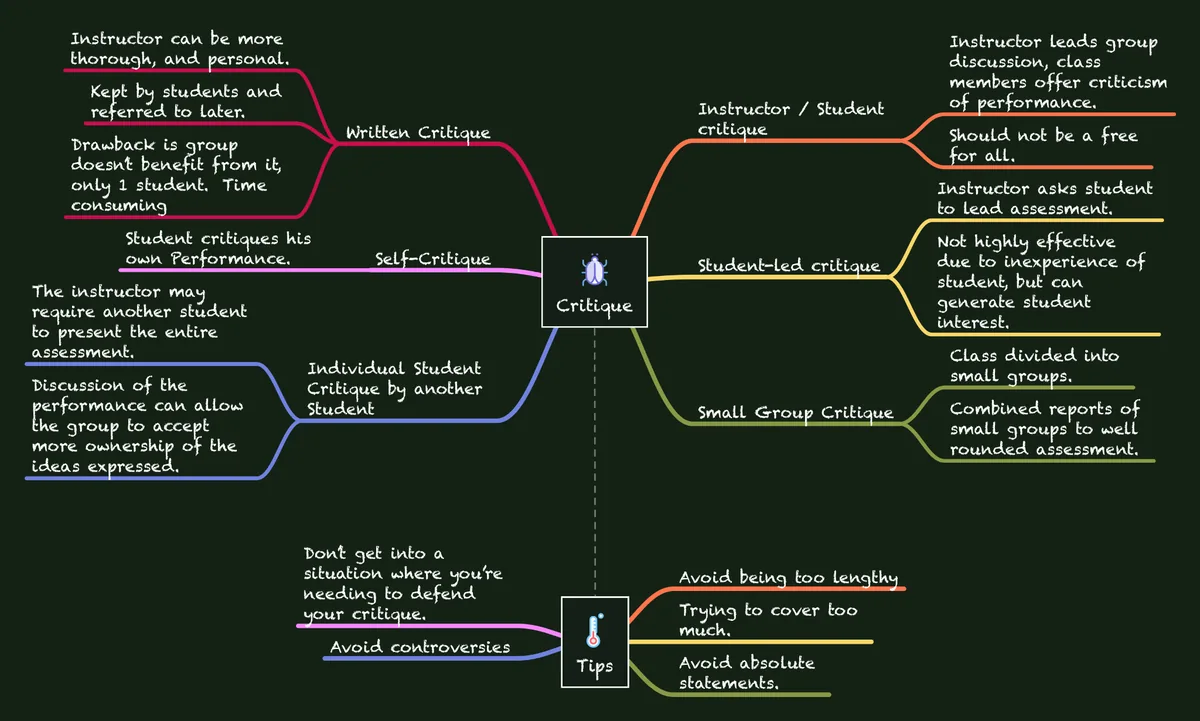
A critique is not a verdict. Its purpose is mastery, which is why it is delivered while the flight is fresh and aimed at the performance rather than the person. The usual form is instructor and learner talking it through, but a learner-led critique hands the assessment over, and small group work or one learner critiquing another shares ownership of it in a classroom. Self-critique under your supervision is the one that eventually has to work alone, because after the checkride there is nobody in the right seat. A written critique gives you room for detail and the learner something to keep.
There is real risk in delivering one badly. A critique that turns personal, is delivered in front of an audience, or arrives too late to be remembered does more damage than silence — and a debrief at altitude competes directly with flying the airplane.
Assessing piloting ability
Assessment of flying is a judgment about how, what and how well learning is occurring. Base it on the standard, adjusted for experience — a pre-solo student and a commercial candidate are held to different things on the same maneuver. Consider mastery of the individual elements, not just whether the maneuver came out acceptable, because a good result from three compensating errors is not a good maneuver. Keep the learner informed of where they stand; nobody should be surprised at a stage check.
Where safety permits, let a learner progress part way into a mistake and find their own way out; the recovery they perform themselves is worth more than the one you performed for them. Varying the order of procedures, or combining a maneuver with another operation, keeps you assessing understanding rather than a memorized sequence.
Where the regulations touch this
Most of assessment is judgment, but a few pieces are legally required, and for those the Code of Federal Regulations is the authority. It changes. Read the current section rather than this page, and rather than a memory of a section.
14 CFR 61.87, Solo requirements for student pilots, requires a student pilot to demonstrate satisfactory aeronautical knowledge on a presolo knowledge test administered by the instructor who endorses the student for solo flight, and requires that instructor to review all incorrect answers with the student before authorizing the flight. The section also lists the maneuvers and procedures that must be trained and found proficient for the make and model to be flown; that list belongs to 61.87, not to a summary of it.
14 CFR 61.39, Prerequisites for practical tests, carries two things worth knowing separately. One is the endorsement from an authorized instructor certifying that the applicant has received and logged the required training and is prepared for the practical test. The other is the timing: as 61.39 reads today, that training must have been received and logged within the 2 calendar months preceding the month of application. That window is the detail that catches schedules out, so read the current text of 61.39 against the applicant's logbook dates before anyone books a test.
14 CFR 61.189, Flight instructor records, is broader than an endorsement file. It requires you to sign the logbook of each person to whom you give flight or ground training, and to maintain a record of the name of each person whose logbook or student pilot certificate you endorsed for solo flight privileges, and of each person you endorsed for a knowledge or practical test — including the kind of test, the date and the results. As 61.189 reads today those records must be retained for at least 3 years, which is the part CFI applicants are asked about most often. Cite the section, keep the file.
Where you meet it next
On the CFI practical test this is Fundamentals of Instructing, Task I.D, and the examiner usually asks it two ways: what makes an assessment effective, and then a grade for the maneuver they just watched you teach, with a reason. The question types to avoid come up most often.
It sits directly on top of the lessons around it. The learning process gives you the laws of learning that assessment leans on, human behavior and effective communication decide whether the critique is heard at all, course development and lesson plans set the completion standards you are grading against, and the endorsement lessons — presolo and cross-country endorsements, and logbook entries — are where the paperwork side of this becomes a signature with your certificate number under it. The rest of the lessons are what you will be assessing; this is how you find out whether any of it took.
Figures