Learn › Teaching › Elements of Effective Teaching in a Professional Environment
Elements of Effective Teaching in a Professional Environment
Every other subject on the CFI checkride is something you know. This one is something you are — and it decides how much of everything else actually reaches the student.
Fundamentals of Instructing — FI.I.E
Why this is a task at all
The examiner is looking for evidence that you will behave in a way that produces a safe pilot on a day when the student is slow, the schedule is full, and you would rather be somewhere else. That is not something you can demonstrate by reciting a definition, which is why the task sits in the standards on its own.
Your professionalism decides how much of your instruction actually lands. A student who does not believe you are a competent pilot filters everything you say through that doubt. A student who does believe it will copy you — your checklist discipline, your fuel decisions, your willingness to cancel — long after they have forgotten the words you used. You are not only teaching maneuvers. You are setting the standard the pilot will hold themselves to when nobody is watching.
What you owe the learner
The first responsibility is helping the learner learn. Make the training enjoyable and interesting, and make the standards clear from the start. A student who knows exactly what "good" looks like can measure their own progress; a student who is guessing gets discouraged for no reason.
The second is providing adequate instruction, and that begins with analyzing the person, not the syllabus. Personality, the way they think, what they can already do — all of it changes how you should teach. The quiet student who needs to see it once and try it themselves is not taught the same way as the one who wants the theory laid out first. Same lesson, different route in.
The third is maintaining standards of performance, and it is the one most often quietly abandoned. The pressure to sign someone off, to call a landing good enough, to move on because the airplane is booked, is real and constant. Lowering the standard feels kind in the moment and does lasting damage, because the student then carries a false idea of what acceptable means.
The fourth is emphasizing the positive. Introduce every maneuver as something worth being able to do, not as a hurdle. Stalls introduced as training in how the wing behaves as it approaches the critical angle of attack, and in the recovery that follows, produce a different pilot than stalls taught as something frightening the FAA makes you sit through.
Minimizing frustration
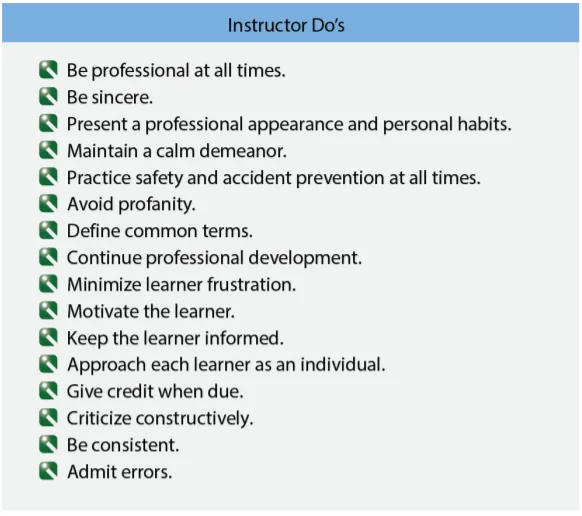
Frustration gets in the way of learning, and the Aviation Instructor's Handbook answers it with seven items. Learn them as seven, because an examiner may ask you to produce the list rather than the sentiment. Motivate students by connecting each lesson to something they actually want to do. Keep students informed — tell them what is coming, how they are doing, and what happens next, because uncertainty is itself a source of stress. Approach students as individuals rather than as a class average. Give credit when due; a student who does something well and hears nothing assumes it was not good. Criticize constructively, which means naming the specific thing that went wrong and the specific fix, not delivering a verdict on the person. Be consistent, so the rules do not appear to move between lessons. And admit errors plainly — you will make them, and a student who watches you own a mistake sees what accountability looks like in a cockpit.
The assessment nobody sees
Beyond teaching, you are continuously assessing. You need an honest read of what the student can actually do rather than what the logbook says, and an eye for physiological obstacles — fatigue, dehydration, illness, medication, stress, the effects of altitude. A student who is not fit to fly today does not learn today, and the lesson you push through anyway is wasted money and added risk.
You also carry the ground instruction on the items the FAA singles out for extra attention, historically called special emphasis areas. In the current Airman Certification Standards these appear woven into the knowledge and risk management elements of each task rather than as a separate list, but the obligation is unchanged: they are yours to teach, and the examiner may probe any of them.
Qualifications and professional image
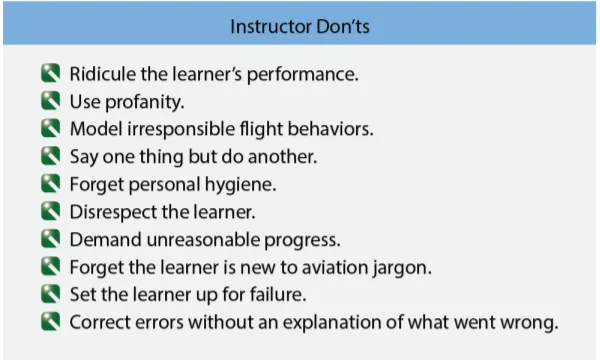
Be honest and direct. When a student's performance is deficient, say so and say what to do about it — avoid drifting into unrelated topics or softening the point until it disappears. Vagueness is not kindness; the student leaves without knowing what to fix.
Accept students as they are, faults included. Never make the student the target — no sarcasm, no comparisons, no degrading behavior in the airplane or in front of others. Encouragement and support are not decoration; they are what keeps someone coming back to do a hard thing badly until they can do it well.
The rest is unglamorous and it works. Be neat and clean. Keep your language professional. Be well prepared for every lesson, because arriving unprepared tells the student their time was not worth your evening. Keep a pleasant, competent manner — a relaxed instructor produces a relaxed cockpit, and a relaxed student hears you. Your demeanor is the evidence the student uses to decide whether you are worth listening to, and they start collecting it before the preflight.
Professional development
You are teaching from a body of knowledge that changes. Improving your own qualifications keeps your instruction accurate, and fresh material is the cure for the lesson you have given so many times you no longer think about it.
The FAA side is free and close at hand: safety seminars, published articles, the regulations and advisory circulars themselves, the WINGS Pilot Proficiency Program run through FAASafety.gov, and the Gold Seal Flight Instructor Certificate as recognition of a sustained record. Beyond that there are classes at educational and training institutions, courses and training materials from commercial organizations, and the publications and programs of the industry associations.
Keep current source material within reach and actually current: the regulations, the Aeronautical Information Manual, the applicable ACS — which has replaced the PTS for the certificates and ratings that have transitioned — and the relevant advisory circulars, plus commercial handbooks, periodicals and technical journals. Teaching from a five-year-old handout is how instructors pass on rules that no longer exist.
Two regulatory pieces sit inside this, and both are worth reading in the original rather than in summary. 14 CFR 61.189, Flight instructor records, covers signing the logbook of each person you train and keeping a record of the endorsements you give, including which endorsements and for how long. 14 CFR 61.197 is now titled Recent experience requirements for flight instructor certification, and the change of title is the point: a final rule effective 1 December 2024 removed the expiration date from the flight instructor certificate. The certificate no longer expires. What the section now requires is that you have met one of its recent experience requirements within the preceding 24 calendar months before exercising flight instructor privileges — a refresher course, an activity-based qualification, a pass-rate route and the other options it lists — with a recent experience end date in place of the printed expiration, a reinstatement provision for a short lapse, and transition language for certificates issued before that date that still show an expiration on their face. Read 61.189 and 61.197 themselves and check the current text before you rely on either. The Code of Federal Regulations is the authority here, it changes, and this page is not a substitute for it.
Ethics and conduct
The Flight Instructor Model Code of Conduct is a useful way to check your own teaching, because it describes the pilot you are trying to produce. Read it in the original; what follows is a summary of its themes rather than its wording. It asks for safety as the first priority, sound judgment and decision-making, effective management of risk, accountability for one's own actions, responsibility and courtesy toward others, prudent operating practices and personal operating parameters, compliance with applicable laws and regulations, proficiency in control of the aircraft, safe and appropriate use of flight deck technology, confidence across a wide range of flight situations, and respect for the privilege of flight.
Every one of those is learned by watching more than by hearing, which is why the Code reads as a test of the instructor as much as of the student. Personal operating parameters are the clearest case: a student cannot learn personal minimums from an instructor who flies without any, and cannot learn to manage risk from one who never says out loud why today's flight is or is not a good idea. Flight deck technology works the same way. The student will use the autopilot and the moving map the way they watched you use them, including on the days you used them instead of thinking.
Where you meet it next
On the CFI practical test this is an oral task in the Fundamentals of Instructing area of operation — though not for every applicant. Under 14 CFR 61.185 and the Flight Instructor ACS, an applicant who already holds a flight instructor certificate or a ground instructor certificate is not evaluated on the Fundamentals of Instructing area of operation, which covers a large share of initial applicants, since the ground instructor certificate is a common route in. Check 61.185 against your own certificates rather than assuming either way. If you are tested on it, the examiner will usually get at it sideways, asking how you would handle a student who is not progressing, or one who wants to be signed off before they are ready. Answer with the responsibilities above rather than with a personality trait.
It also shows up every time you teach anything else. The other half of this task is the risk management and accident prevention lesson, which is where personal minimums and the decision to cancel get their own treatment. Student evaluation, assessment and testing is where honest standards become a technique rather than an intention; course development and lesson plans is where preparation stops being a virtue and becomes a document; and endorsements and logbook entries is where the record-keeping in 61.189 turns into something you actually write. All of them are in Learn.
Figures