Learn › Technical subjects › The National Airspace System
The National Airspace System
The sky over the United States is cut into six classes. What you may fly into depends on the certificate you hold, the equipment in the panel and the weather at the time — and the answer changes at every boundary you cross.
Technical Subject Areas — FI.II.G
Why the classes exist
The letters are not a ranking of difficulty, and they do not run in the order of anything you can see out the window. They record how much traffic sits in a volume of air and how much of that traffic somebody on the ground is separating. Where the answer is a great deal and all of it, the rules are tight and the door stays shut until someone opens it for you. Where the answer is very little and none of it, the only protection is your own scan. Not knowing which one you are in costs everyone in that volume part of the safety margin.
It is all drawn on charts, which only help while they are current. Sectional and terminal area charts come out on a 56-day cycle, the VFR wall planning chart annually. The Aeronautical Chart User's Guide is the FAA's key to the symbols.
The six classes
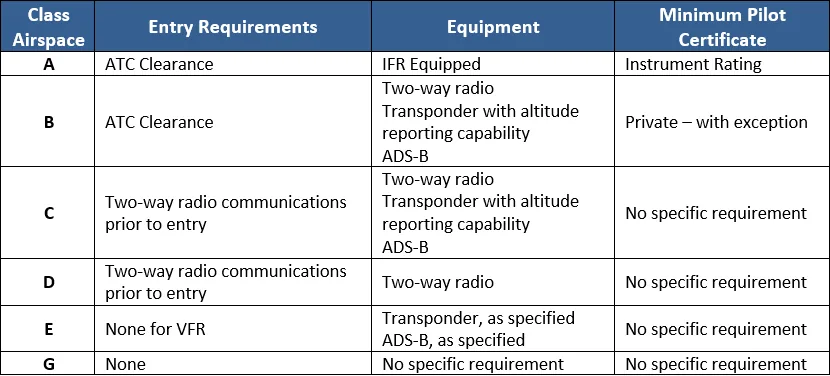
There are six — A, B, C, D, E and G. Ask the same three questions of each and the system collapses into something memorizable: who may enter, what must the airplane carry, and what weather do you need.
Class A
From 18,000 feet MSL up to and including FL600. It is not charted, because it is everywhere above that altitude. All of it is IFR: instrument rating, instrument-capable airplane, clearance, two-way radio, Mode C and ADS-B Out. Above FL240, if VOR is used for navigation, 14 CFR 91.205(e) adds DME or a suitable RNAV system.
Class B
The nation's busiest airports, typically surface to 10,000 feet MSL, though the ceiling varies from field to field and some are higher. Every one is individually tailored, so read the shelves off the current chart every time rather than carrying a shape in your head.
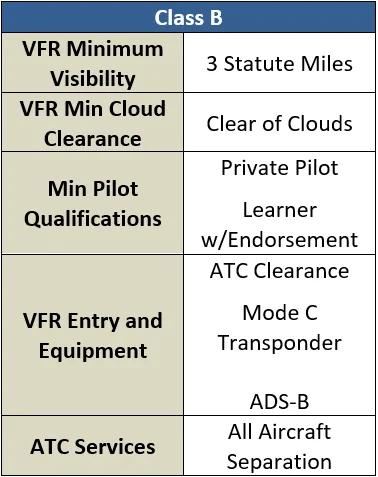
You need at least a private pilot certificate, or the endorsement your own certificate calls for: student pilots under 14 CFR 61.95, recreational pilots under 61.101, sport pilots under 61.325. Three certificates, three separate sections — read the one that applies to you. On top of that, a handful of the busiest fields allow no student solo at all (14 CFR Part 91 Appendix D Section 4, AIM 3-2-3). Entry takes an explicit clearance; equipment is two-way radio, Mode C and ADS-B Out. Weather is 3 statute miles and clear of clouds — the only class whose basic VFR minimums are clear of clouds at every altitude inside it, because ATC separates everybody in there. Clear of clouds turns up twice more on this page, in Class G down low by day and under a special VFR clearance, and neither of those is a whole class at every altitude.
Class C
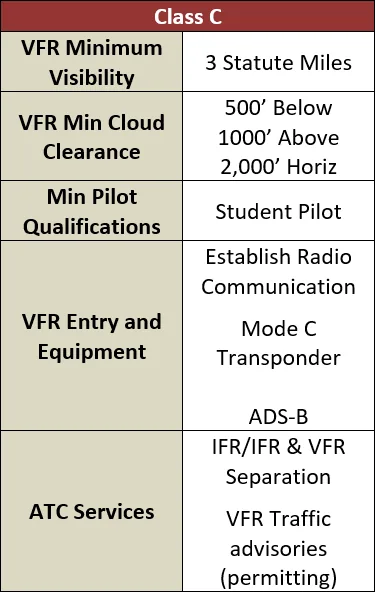
An airport with both a control tower and approach control. A five-nautical-mile core from the surface to 4,000 feet above the airport elevation, and a shelf out to ten miles running from 1,200 feet AGL to that ceiling. Two-way radio, Mode C and ADS-B Out. Entry requires established two-way communication, not a clearance. Weather is 3-152: three statute miles, 1,000 feet above, 500 below, 2,000 horizontally from cloud.
Class D
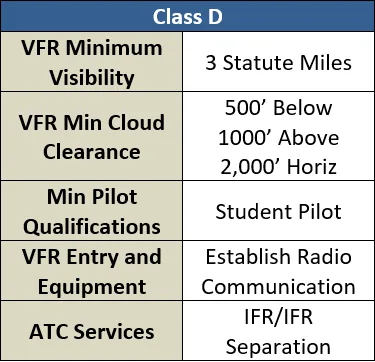
A towered airport without approach control. Surface to about 2,500 feet above the airport elevation, with a radius tailored to the instrument procedures the field serves. The handbooks give no usual figure and neither should you — read the radius off the chart. Two-way radio is the equipment, established two-way communication is the entry, weather is 3-152.
The difference between B and C or D is a favorite checkride question. In C or D, ATC answering with your call sign is the communication you needed; in B, nothing short of cleared into the Class B will do.
Class E
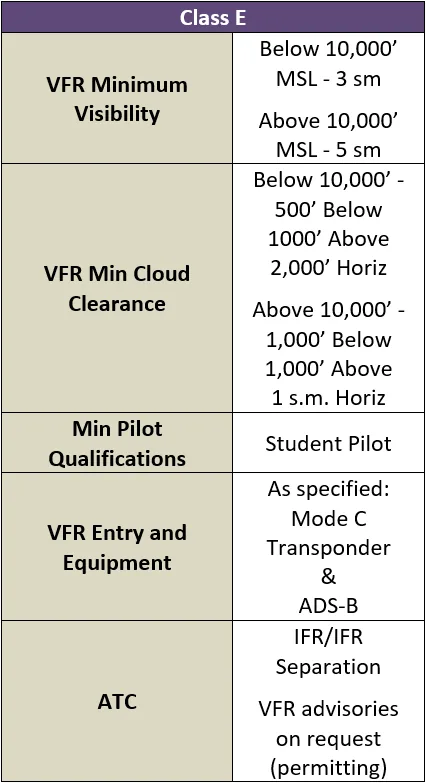
Controlled airspace that is not A, B, C or D — the flexible class that fills the gaps, up to but not including 18,000 feet MSL, and again above FL600. Its floor is 700 feet AGL around non-towered airports with instrument approaches, 1,200 feet AGL over broad areas, the surface where a surface area is designated, and 14,500 feet MSL where nothing else is drawn. That last one carries an exclusion worth knowing in the mountain West: 14 CFR 71.71 does not apply the 14,500-foot floor to airspace 1,500 feet AGL and below, so over terrain high enough to matter the floor climbs with the ground instead.
It is controlled because IFR traffic uses it: it lets an IFR arrival descend from Class A to the runway in controlled airspace the whole way. As a VFR pilot you need no clearance and no radio call, and nobody is separating you from anything. Weather below 10,000 feet MSL is 3-152; at and above 10,000 it becomes 5-1-1-1, the horizontal distance growing because everything up there is moving faster.
Class G
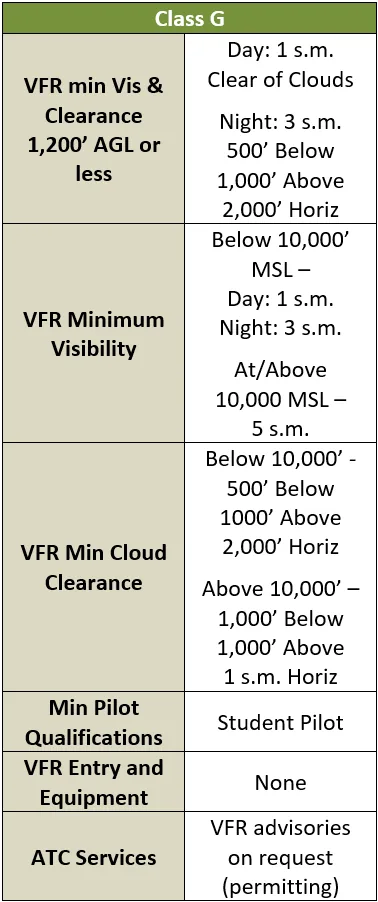
The only uncontrolled airspace in the country, under Class E from the surface to 700 or 1,200 feet AGL in most places. No ATC service, so VFR and IFR traffic alike separate themselves. Its weather minimums are the loosest in the system and the only ones that change with time of day — one statute mile and clear of clouds below 1,200 feet AGL by day, climbing toward the controlled-airspace numbers higher and at night. Read them off the table in 14 CFR 91.155 rather than from memory; it is laid out by altitude and by day or night, and the section is the authority.
Transponders and ADS-B Out
Both are required in Class A, B and C, and then in places with nothing to do with the letter on the chart:
- At and above 10,000 feet MSL, excluding airspace at and below 2,500 feet AGL
- Within 30 nautical miles of a Class B primary airport, from the surface to 10,000 feet MSL — the Mode C veil
- Above the ceiling and within the lateral boundaries of Class B or C, to 10,000 feet MSL
- For ADS-B Out, at and above 3,000 feet MSL over the Gulf of Mexico within 12 nautical miles of the coast
Those are 14 CFR 91.215 and 91.225, and both carry exceptions the list above does not capture. The one you are most likely to meet is for aircraft not originally certificated with an engine-driven electrical system — balloons, gliders, a good many Cubs and Champs. Under 91.215(b)(3) and 91.225(e) those aircraft may operate without a transponder or ADS-B Out outside Class A, B and C airspace and below 10,000 feet MSL, on the terms the sections set out. If you fly a legacy airplane, read the sections themselves. Separately, 91.205 sets the day and night VFR equipment on top of all of this.
Speed limits
Under 14 CFR 91.117: 250 knots indicated below 10,000 feet MSL, and 200 knots at or below 2,500 feet AGL within four nautical miles of a Class C or D primary airport, beneath a Class B shelf, or in a VFR corridor through Class B. If minimum safe airspeed is higher, fly that.
Special VFR
Special VFR lets you operate in a Class B, C, D or E surface area below 10,000 feet MSL when the field is below basic VFR minimums. You must ask for it — ATC will not offer it — and it takes a clearance and flight clear of clouds. On visibility, quote the rule rather than the shorthand, because it asks one thing of a pilot passing through and another of one touching the runway. In the air, 14 CFR 91.157(b)(3) requires flight visibility of at least 1 statute mile and nothing more; transiting a surface area under an SVFR clearance carries no ground visibility requirement at all. To take off or land, 91.157(c) adds one: (c)(1) requires ground visibility of at least 1 statute mile, and (c)(2) lets flight visibility of at least 1 statute mile stand in only where ground visibility is not reported. Helicopters are excepted from both the flight visibility requirement and the takeoff and landing rule. And 91.157(d) settles what a reported half mile is worth: your own determination of visibility under (c)(2) is not an official weather report or an official ground visibility report. Where a value is reported, that is the value that governs, and your estimate out the window does not displace it.
At night, 91.157(b)(4) requires — again except for helicopters — that the pilot meet the applicable requirements for instrument flight under 14 CFR Part 61 and that the aircraft be equipped as required by 14 CFR 91.205(d). It is prohibited at the airports listed in 14 CFR Part 91 Appendix D Section 3, and a solo student pilot cannot use it (14 CFR 61.89). The whole rule is 91.157 and it is short — read it once in full.
It is legal, and it is also one mile of visibility near terrain and towers you cannot see — a tool for leaving a field under a thin layer, not for making a trip work.
Special use airspace
Special use airspace confines activity that would be hazardous to anyone not taking part. Six kinds:
- Prohibited areas — closed, for security or national welfare. Charted with a P, such as P-56 over the National Mall.
- Restricted areas — hazardous but not wholly prohibited. Charted with an R, such as R-6412. You may pass when the area is cold or the controlling agency approves.
- Warning areas — the same hazards, from three nautical miles outward from the coast. Charted with a W. Flight is permitted; the hazard is not.
- Military operations areas — military training separated from IFR traffic, named rather than numbered, such as the Isabella MOA. VFR traffic is always allowed, which is exactly why your scan must be at its best inside one.
- Alert areas — heavy training or unusual activity. Charted with an A, such as A-211.
- Controlled firing areas — not charted, because activity stops the moment a spotter or radar sees an aircraft approaching.
Also charted: special flight rules areas with their own Part 93 procedures, low-level military training routes, terminal radar service areas where participation is voluntary, and national security areas you are asked to avoid.
Temporary flight restrictions
TFRs are not on your chart when you need them, because they are issued in FDC NOTAMs. A few long-standing restrictions of similar effect are drawn: the Washington special flight rules area and the flight restricted zone inside it, the standing restrictions over the Disney parks, and on some sectionals the outlines of areas that go active again and again. The one raised this morning for a fire, a stadium or a visiting official is not among them. Each TFR gives a location, dimensions, duration and description, and the list lives at tfr.faa.gov. Checking is part of every preflight.
All of this is written from the rules as they stand, and rules change. The Code of Federal Regulations is the authority — not this page, not any study guide, and not the version of a section you learned last year. Where a number here matters to a flight, open the section cited beside it.
Where you meet it next
On the practical test an examiner hands you a sectional and asks what you need to enter a piece of it. The answer is the same three questions in the same order: certificate, equipment, weather. Then the follow-ups — can you fly through a restricted area, and how did you find out about that TFR.
In the airplane it is a decision made before you get there, not at the boundary. Draw the shelves on your route, note the floors, and know the frequency while the airspace is still ahead of the nose.
- Decoding METARs — the reported visibility and ceiling you hold these minimums against, including the ground visibility that governs a special VFR departure or arrival
- Estimate the cloud base before you commit to a surface area or a climb through a Class E floor
- Open the charts and trace the airspace along a route you plan to fly
- More lessons
Figures