Learn › Technical subjects › Runway Incursion Avoidance
Runway Incursion Avoidance
Aviation's worst accident happened with everyone still on the ground. The taxi is the phase of flight where the workload feels lowest and the airplane is still sharing pavement with everybody else.
Technical Subject Areas — FI.II.C
Why the ground gets its own lesson
Treat the trip from ramp to runway and back as a phase of flight rather than the boring bit at either end of one. The airplane is slow and the workload feels low, and that combination loosens your attention exactly where a mistake puts you in front of something moving at 120 knots.
The case everyone cites is Tenerife, 1977. Two Boeing 747s collided when one began its takeoff roll while the other was still taxiing on the same pavement, in fog, after a readback everyone heard the way they expected to hear it. Nobody was flying. Everybody was on the ground.
What counts as an incursion
The definition in the Pilot/Controller Glossary is deliberately broad: the incorrect presence of an aircraft, vehicle, or person on the protected area of a surface designated for the landing and takeoff of aircraft. Notice what is missing. No collision, no near miss, and no requirement that anything be moving. Being somewhere you were not cleared to be is the event, and you can commit it sitting still.
They come from three directions — pilots who deviate from a clearance, vehicles and pedestrians on the movement area, and controllers who make an operational error. Only one of those is yours to control, and it is the one behind most of the general aviation numbers. So the rest of this is airport operations, phraseology, lighting, and signage.
Taxiing at a towered airport
Work the sequence the same way every time: plan, brief, call, review. Plan the route on the airport diagram before you move. Brief it out loud, hot spots included. Make the radio call. Then review what you were told against what you planned.
A taxi clearance contains three things — a destination, a route, and any hold short instructions or runway crossing clearances. Write it down. Not because your memory is bad, but because writing makes you hear it a second time and gives you something to check against three turns later. Read back every runway crossing and hold short instruction, without exception. And a clearance to taxi to a runway is not permission to cross one; each runway on your route needs its own explicit crossing clearance.
The regulatory floor under this is 14 CFR 91.129(i), which reads: “No person may, at any airport with an operating control tower, operate an aircraft on a runway or taxiway, or take off or land an aircraft, unless an appropriate clearance is received from ATC.” Read the runway or taxiway part again — that is why you need a clearance to move at all at a towered field, not merely to use the runway. What you then do with the clearance is governed by 14 CFR 91.123. Go to the sections themselves rather than to this paragraph: the CFR is the authority and it changes.
Saying it properly
Listen before you talk so you do not step on someone. Then give four things in order: who you are calling, who you are, where you are, what you want. “Provo Ground, Diamond Star 123UV at the south general aviation ramp with information Alpha, ready to taxi.” Later, “Provo Tower, Diamond Star 123UV holding short runway 13, ready for departure.” Give your position the way it appears on the airport diagram, not by the local name for the building you parked behind — the point of a position report is that someone who has never seen you can find you. If you did not understand something, say “say again.”
What you do with your eyes
Eyes out, ears out. A visual scan beats a screen scan every time, and a moving map is a cross-check on what you already believe, not a substitute for looking. If you need to work heads-down, stop first — and stop somewhere you are entitled to be, short of the hold line and clear of the protected surface. Stopping is not by itself a defense: presence is the event, so an airplane parked past the hold line or sitting on a runway without a clearance is an incursion whether or not the wheels are turning. Keep the flight deck sterile while you are moving, too. The airline rule against non-essential conversation below 10,000 feet costs you nothing on a taxi, and distraction is the mechanism behind the deviation that follows.
Reading the airport
The airport tells you where you are in three languages, and they agree.
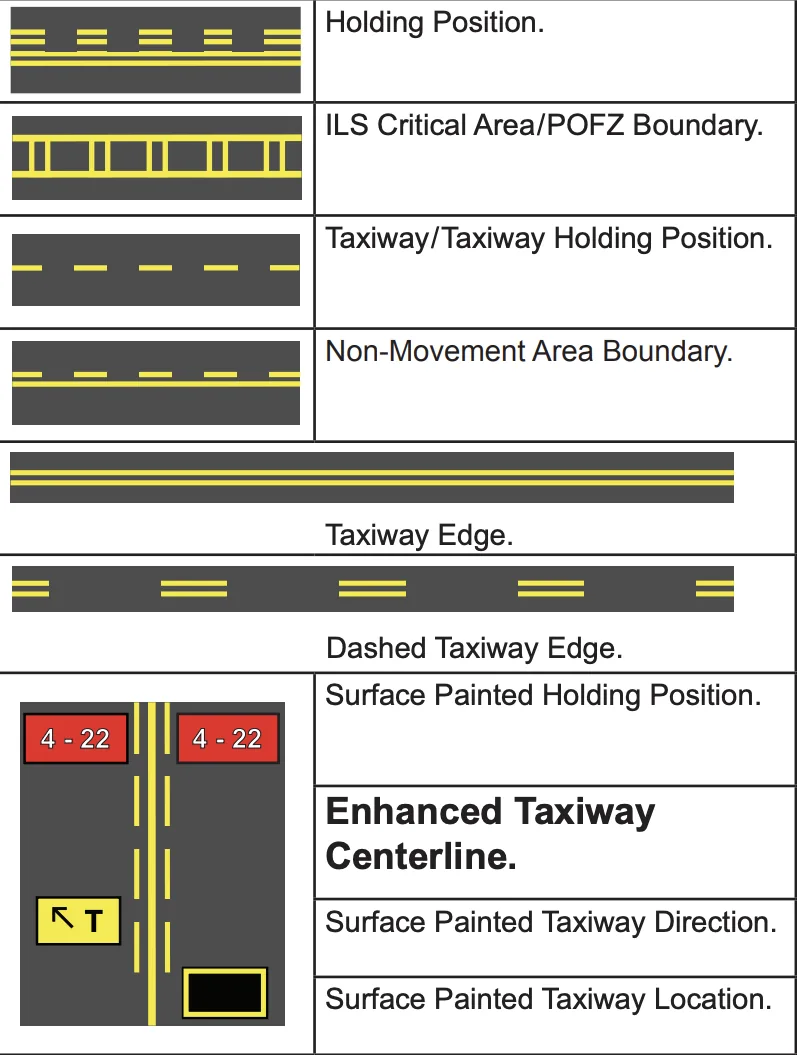
Markings are painted: white on runways, yellow on taxiways. The one that matters most is the runway holding position marking — four yellow lines, two solid and two dashed. The solid pair is always on the side you hold on, so if the solid lines face you, you stop. If you meet the dashed pair first you are coming off a runway, and you are not clear of it until the whole airplane, tail included, is past the marking.
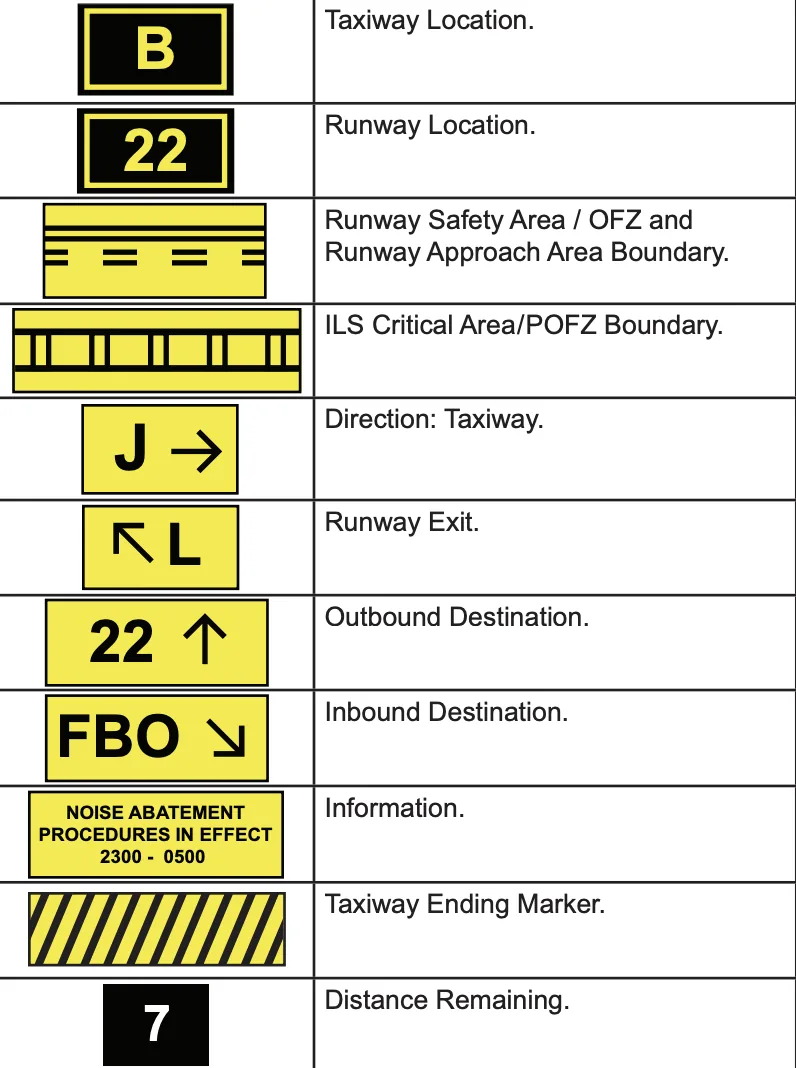
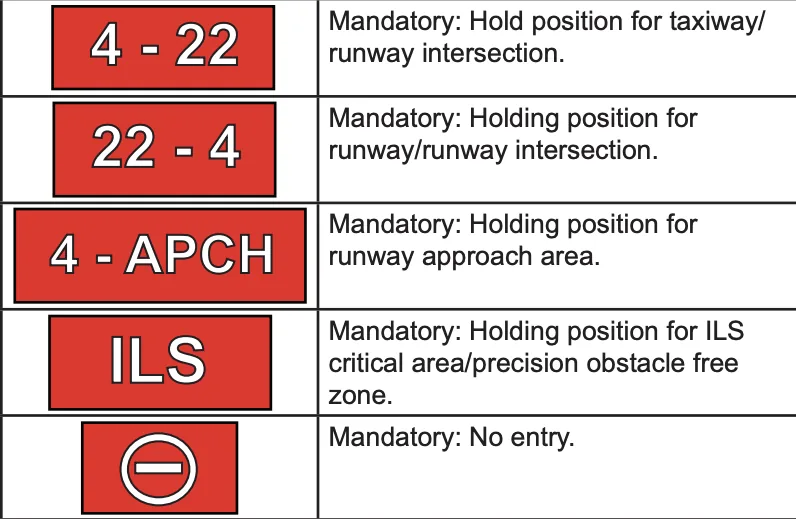
Signs come in colors that mean things. Red with white lettering is mandatory: it names the runway ahead and you do not pass it without a clearance. Black with yellow lettering tells you the taxiway you are on. Yellow with black lettering points to where things are.
Lights take over when the paint stops working. Taxiway edge lights are blue, taxiway centerline lights green. Runway edge lights are white, and on instrument runways turn yellow for the last 2,000 feet or the last half of the runway, whichever is less. Runway centerline lights, on precision instrument runways, sit at 50-foot intervals: white, then alternating red and white for the last 3,000 feet, then red for the last 1,000. Many airports also have flashing yellow runway guard lights at the hold line, which exist for one reason.
Non-towered airports
Here you are your own controller, and so is everyone else. Self-announce on the CTAF in two separate sequences. Departing: before you taxi, and again before you taxi onto the runway. Arriving: about 10 miles out, then entering downwind, base and final — and once more when you are clear of the runway, which is the call this lesson cares about most, because it is what tells the airplane on final that the pavement is free. Same four-part format as at a towered field.
Bring the eyes-out mentality with you, and bring it harder. Radios are not required at a non-towered field, so a quiet frequency proves nothing about a clear runway. Look down the final approach course before you line up, every time.
The situations that catch people
Hot spots are the FAA's own list of confusing intersections, published on airport diagrams and in the Chart Supplement. Somebody already had the problem you are about to have there. Find them in planning and say them out loud in the brief.
Night and low visibility strip out cues you were relying on without noticing, and a taxiway can look like a runway when all you see is a row of lights. Slow down, use the signs rather than the shapes, and ask for a progressive taxi if you are unfamiliar — controllers would rather talk you along than write up a deviation.
Taxiways between parallel runways put a hold line on each side of you. Know which one your clearance referred to.
Confirmation and expectation bias is the quiet one. You expect to be cleared to cross, so you hear a clearance to cross. You expect 13, so 13 is what you read back. This is what got Tenerife, and experience does not make you immune. The defense is mechanical: write it, read it back, and if what you are about to do does not match what is on your kneeboard, stop and ask.
After landing
The risk does not end at touchdown. Exit the runway completely, and only then start the after-landing items. Do not turn onto another runway without a clearance, and do not stop with any part of the airplane inside the hold line. Afterward, go back to the diagram and review where you actually went — that is how the next taxi gets easier.
If you are offered a land and hold short clearance, accepting is optional and declining is free. The AIM's guidance in 4-3-11 is that student pilots, and pilots unfamiliar with LAHSO, should not accept one at all, and no pilot should accept without knowing the available landing distance and being certain of stopping in it.
What you actually do about it
- Become familiar with the airport before you go, not while you are rolling.
- Review the layout, the signage, and the hot spots on the diagram.
- Write down every taxi instruction, and read back every crossing and hold short.
- Turn your lights on to taxi, and add more when you cross or enter a runway.
- Look for traffic before entering any runway, towered or not.
- Stop the airplane short of the hold line before you go heads-down.
- After landing, clear the runway quickly, but safely.
Where you meet it next
This is its own task in the Flight Instructor ACS — FAA-S-ACS-25, Area of Operation II, Technical Subject Areas. At Private and Commercial it is not a separate task: it lives in the knowledge and risk elements of Preflight Procedures, Taxiing, at PA.II.D and CA.II.D. Most of the evaluation happens by observation — whether you wrote the clearance down, read back the hold short, had your eyes outside at the hold line, and knew the hot spots before you moved. But those knowledge and risk elements are asked about too, and signs, markings, lighting, hot spots and readback are ordinary oral questions, so prepare the ground knowledge as well as the taxi. Every checkride begins and ends on the ground.
The next lessons that touch this one are Night Operations, for the lighting and the cues that go missing after dark; Visual Scanning and Collision Avoidance, which is the same eyes-out discipline applied in the air; and Teaching Risk Management and Accident Prevention, where expectation bias gets its proper treatment. They are all in Learn.
Before any of that, pull the airport diagram and the hot spot list for your home field in the app and brief them once with the engine off. The briefing you give yourself in the airplane then gets much shorter.
Figures