Learn › Maneuvers › Soft-Field Takeoff and Climb
Soft-Field Takeoff and Climb
A soft surface drags at the tires and can bury the nosewheel. The answer is to fly the airplane off at the lowest speed that works and let ground effect do the accelerating.
Takeoffs, Landings and Go-Arounds — FI.VII.C
Why the maneuver exists
Your home field almost certainly has a hard surface, a painted centerline and a number on each end. A lot of the airports worth flying to do not. They have turf, dirt, gravel, or packed snow, and if you intend to land at one of them you also have to be able to leave it again. That is the whole reason this maneuver is on the syllabus: it is what buys you the interesting destinations.
A soft surface works against you in two ways. It drags — grass, mud, sand and slush all pull at the tires, so it takes more power just to keep moving and the takeoff roll is longer than the chart suggests. And it swallows things. A nosewheel that digs in can stop the airplane hard, on its nose. So the job is to get the weight off the wheels and onto the wings as early as you possibly can, and to never stop moving once you are on the soft stuff.
Gravel and other loose surfaces add a third reason for the same technique, and it has nothing to do with bogging down. The wheels and the prop blast throw stones, and the propeller is turning right where they go. Holding the nose high and getting the airplane off early keeps the blades as far from that debris as the geometry allows, which is why the technique is worth flying on a rough dry strip that would never have swallowed anything.
Ground effect is the thing that makes it work
Within roughly one wingspan of the surface, the ground interferes with the airflow around the wing. Upwash, downwash and the wingtip vortices are all reduced, and with the vortices weakened, induced drag drops. That is enough that the airplane can become airborne down there at a speed which will not sustain flight out of ground effect. Can, not will: how much margin it buys you on a given morning depends on weight, density altitude and the power you actually have.
That is what you are exploiting. You lift off slower than you otherwise could, stay in that low-drag pocket, and use it to accelerate. The bill comes due when you leave it: out of ground effect the wing needs a higher angle of attack for the same lift, induced drag and required thrust both go up, and the nose tends to pitch up as downwash over the tail increases. Climb out too early and the airplane will settle back toward the surface even with full power in.
Check, configure, brief
Check the performance charts in your POH or AFM and decide whether the airplane can actually do this today, at this weight, at this field. High density altitude cuts engine and propeller output, stretches the ground roll and flattens the climb — and a soft surface has already stretched the roll for you. Then check the wind, from the ATIS, a METAR, or the windsock, and let it decide your runway, your crosswind technique, and what you expect from wind shear, tailwind or wake turbulence. Look at the surface itself while you are at it: how wet it is, how tall the grass is, whether the field slopes, and whether there is a firmer line to follow.
Configure before you go anywhere near the takeoff area. The run-up and the pre-takeoff checklist get finished while you are still on firm ground, because you are not going to be stopping out there to do them. Engine instruments reading normally, controls full free and correct, flaps and trim set as the POH calls for.
Brief what you will do when it goes wrong. Where you would put the airplane if the engine quit just after liftoff, given the departure path, the altitude you had, the terrain and the wind; what a rejected takeoff looks like on a surface you cannot brake hard on; and what you will ignore if something distracts you at the worst moment. On a field with no centerline, add one more item — know where you are on the surface and where the edges are.
Flying it
Hold the yoke back from the moment the airplane starts rolling and keep it there through the taxi — with the crosswind exception intact, because the taxi rules do not stop applying just because the surface is soft. Climb into a headwind, dive away from a tailwind. With the wind quartering from behind you the elevator belongs forward, not aft, and you protect the nosewheel with a slow taxi and a light touch rather than with back pressure you are not entitled to use. Steer with rudder and stay off the brakes.
Clear the final approach and the takeoff path before you roll on. You are deliberately giving up the pause on the runway where most pilots do that looking, so the looking has to happen while you are still taxiing. Then keep moving: roll onto the takeoff path without stopping, advance the power smoothly, and cross-check the engine instruments as it comes up.
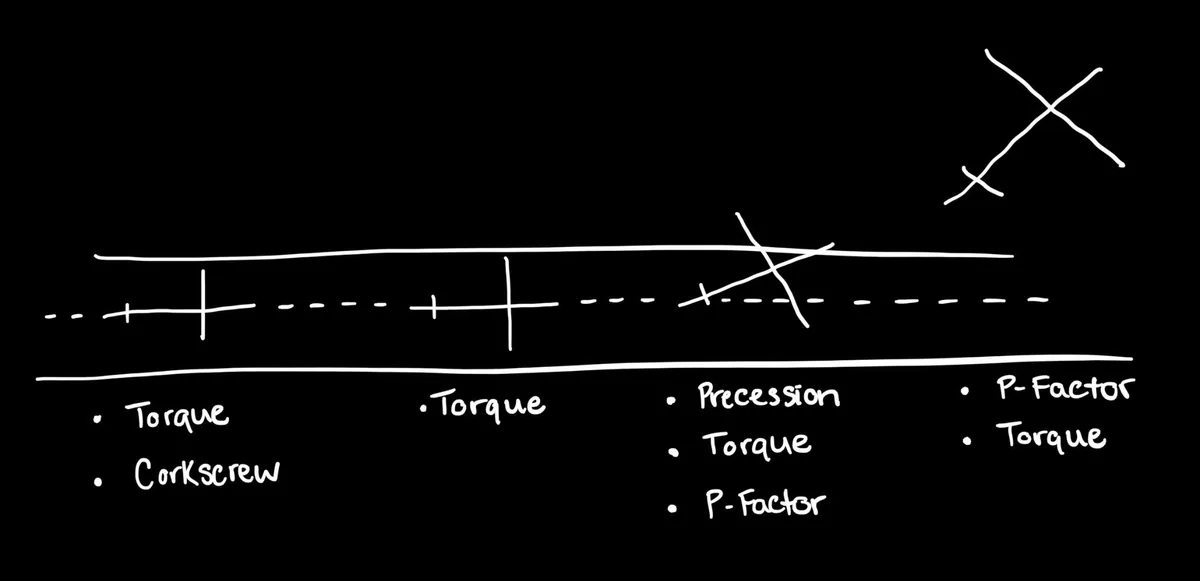
At full power and low airspeed the left-turning tendencies are at their strongest. Torque, the spiraling slipstream striking the fin, and P-factor from the descending blade all pull the nose the same way, and you are holding a high pitch attitude that makes P-factor worse. Feed in rudder and hold the takeoff path.
The nose will come up on its own well before you have flying speed. When it does, relieve some of the back pressure and hold the nosewheel just clear of the surface — hold that attitude and the airplane will fly itself off. As soon as the wheels are clear, lower the nose a little and level off inside ground effect, a few feet up, and let the airplane accelerate there. Then climb: at Vx if there is an obstacle to clear, otherwise at Vy, and both of those speeds come from your POH rather than from anyone's rule of thumb. With a positive rate established and the airplane accelerated, retract the gear and the flaps on the schedule your airplane uses, and pick up the rest of the departure checklist.
What goes wrong
The two errors that account for most of it sit on either side of liftoff. The first is not enough back pressure during the roll, which leaves too little angle of attack and too much weight on the nosewheel — precisely the thing the maneuver exists to prevent. The second is climbing too high after liftoff, out of ground effect before the airplane has the speed to stay there, at which point it mushes, settles, and touches down again on a surface it was never meant to touch at that attitude.
Around those two: yanking or shoving the elevator while trying to level off instead of making one smooth change; using brakes for directional control on a surface where they may do nothing useful; skipping the engine instrument cross-check after the power comes in; rolling onto the takeoff path without having looked at final; and being surprised by the pitch-up as the airplane leaves ground effect.
Where you meet it next
Soft-field takeoff and climb is a required task on the private pilot practical test and again on the commercial, and the examiner grades the whole task rather than the one skill it is named for. Keeping weight off the nosewheel, yes — but also directional control, the climb speed and the tolerance the ACS puts around it, checklist use, and the configuration changes made on schedule. Its mirror image is the soft-field landing, where you hold the nose off after touchdown for the same reasons and keep enough power to avoid bogging down. Its opposite number is the short-field takeoff, which solves an obstacle rather than a surface, and asks for a precise rotation speed rather than the lowest one that works. Both sit alongside this one in the maneuvers lessons, next to slow flight and the go-around — and the habit you build here, of feeling how much lift the wing is making before the airspeed indicator agrees with you, is the habit those two run on.
Figures